

SA303 12V DC 3 Wire 3-point
SA303 provides three-wire, three-point or floating-point actuator control with clockwise (CW) and counter-clockwise (CCW) inputs. Powering one control input opens the valve; powering the other closes it. With neither input powered, the actuator stays in its last position.
Wiring Diagram
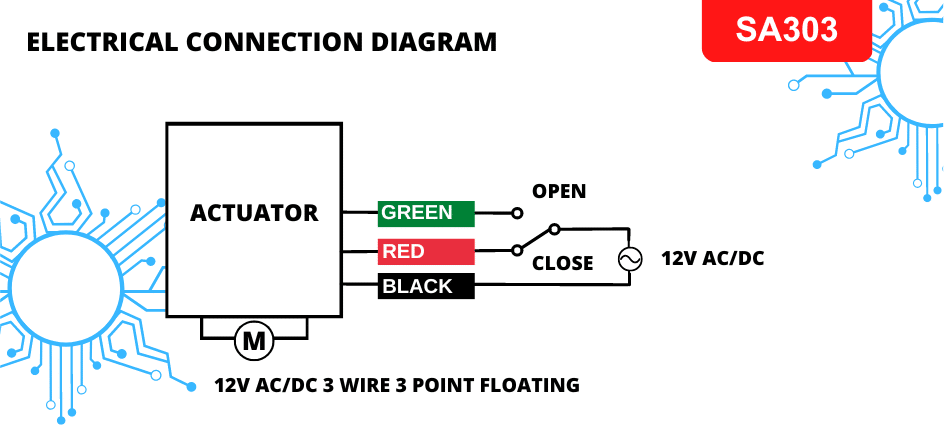
Wire Connections
Disconnect power before making or changing connections.
- Connect the black wire to the negative terminal of the 12V DC supply.
- Connect positive 12V DC to the green wire to open the valve.
- Connect positive 12V DC to the red wire to close the valve.
- The actuator moves in the selected direction while that control input is powered, until it reaches its travel limit. Removing power from both control inputs leaves it in its current position.
The supplied instructions also describe 12V AC connections, using neutral for the black common wire and switched phase for the green or red control wire. Check the actuator's label or datasheet to confirm the permitted supply type before using AC power.
Floating-Point Positioning Example
For a valve with an assumed operating time of 10 seconds for 90° of travel, applying the opening input for 5 seconds moves it approximately 45° open. Removing the input leaves the valve in that position.
Applying the opening input again for more than another 5 seconds moves the valve fully open, where the internal limit switch stops the motor. This is an illustrative timing example, not a specified operating time for every actuator.
Internal Limit Switches
Although the actuator supports floating-point control, the internal motor stops when the fully open or fully closed limit switch is triggered. Keeping the relevant CW or CCW input powered after reaching that limit does not keep the motor rotating.
Floating-point control can serve as a partial alternative to proportional control. Appropriate feedback mechanisms can be used to control the valve's angular position.